In the last few decades, the astrophysics community has made a big effort to understand galaxy formation and evolution, and the interplay between internal and external processes such as the action of density waves, dynamical friction, galaxy-galaxy or galaxy-environment interactions. In spite of the huge progress in this field, one of the major unresolved issues is the role of such large-scale processes in the formation of small stellar structures in the center of galaxies.
After my PhD, I expanded my knowledge in the field of galaxy evolution as a postdoc in the Galactic Nuclei research group at MPIA (October 2019 – July 2023). The Galactic Nuclei group is a heterogeneous team analyzing nuclear regions of galaxies from different points of view and using different approaches: photometry or spectroscopy. Some of us focused on nuclei in external galaxies, some others on the Milky Way nucleus or on stripped nuclei. After that, I kept on working on galactic nuclei as one of my two main research lines, and I am currently leading the observational analysis of galactic nuclei in the PHANGS and BEARD surveys (see below). I am pioneering the analysis of galactic centers at small scales in high-resolution cosmological simulations with my Marie Curie project “TraNSLate: Tracing galaxy evolution with Nuclear Structures in Late-type galaxies” (see below).
Nuclear star clusters. Of particular interest in this context are compact structures located at the centers of galaxies.
With sizes of a few parsecs and masses of up to a few times 10^7 solar masses, nuclear star clusters (NSCs) are the densest stellar systems in the universe (see, e.g., review by Neumayer, Seth & Böker 2020). Most galaxies of all morphological types with stellar masses between 10^8 and 10^10 solar masses host NSCs, whose properties, such as mass and luminosity, scale with host-galaxy properties. NSCs can form via two different channels: 1) star-cluster inspiral to the center (Tremaine et al. 1975), and 2) in-situ star formation at the center of a galaxy (Brown et al. 2018). These two scenarios are not mutually exclusive, and both can contribute to NSC formation (Fahrion et al. – incl. Pinna, 2021). Both channels are tightly linked to galaxy-evolution processes at larger scales, such as dynamical friction (leading to star-cluster infall), gas inflow and gas or star-cluster accretion through galaxy mergers.
OBSERVATIONAL WORK
NSCs in galaxies of different morphological types. In Pinna et al. (2021) I presented a unique adaptive-optics assisted survey of the very central regions of eleven early- (ETGs) and late-type galaxies (LTGs), providing the spatially resolved kinematics, at parsec (pc) scale, of the regions dominated by the NSCs. This work uncovered, for the first time, a trend of nuclear kinematic properties with galaxy morphology, pointing to different NSC formation scenarios: in-situ star formation as the leading mechanism in LTGs, and star-cluster mergers for ETGs. Since ETGs and LTGs have different evolutionary paths, this trend affirms a strong impact of galaxy evolution on the formation and growth of NSCs.
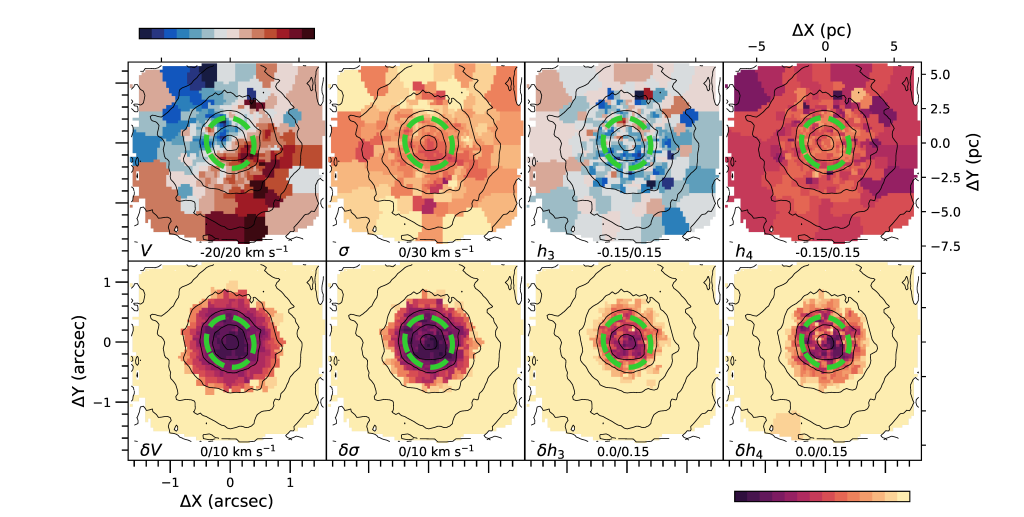
For the nuclear region of M33, in the top row from left to right: mean velocity V , velocity dispersion, skewness h3 and kurtosis h4. Their respective uncertainties are shown in the bottom row. The maximum and minimum values of the color bar are indicated at the bottom of each panel. The original data cube was Voronoi-binned to a signal-to-noise ratio (S/N) of 25 per bin. Different isophotes are plotted in black to guide the eye. The dashed magenta ellipse corresponds to elliptical isophote at the NSC effective radius. From Pinna et al. (2021).
NSCs in galaxies of different masses. I was also part of a systematic study of a sample of 25 unresolved NSCs hosted by ETGs (Fahrion et al. – incl. Pinna, 2021), whose integrated spectra were disentangled from the host galaxy (in a point-spread-function aperture). We fitted these spectra with full-spectral fitting and extracted age, metallicity and star-formation histories of NSCs. Their properties show trends with galaxy mass and their comparison with the host galaxy helped us reveal a diversity of formation scenarios, also depending on galaxy mass. Additionally, we have very recently analyzed a sample of nine NSCs in dwarf LTGs (Fahrion et al. – incl. Pinna – 2022), previously unexplored types. In these galaxies, we find a similar trend with galaxy mass, but lower NSC metallicities on average than ETGs of similar masses. This suggests that NSCs in LTGs may form in a different way.
NSCs in massive spiral galaxies.
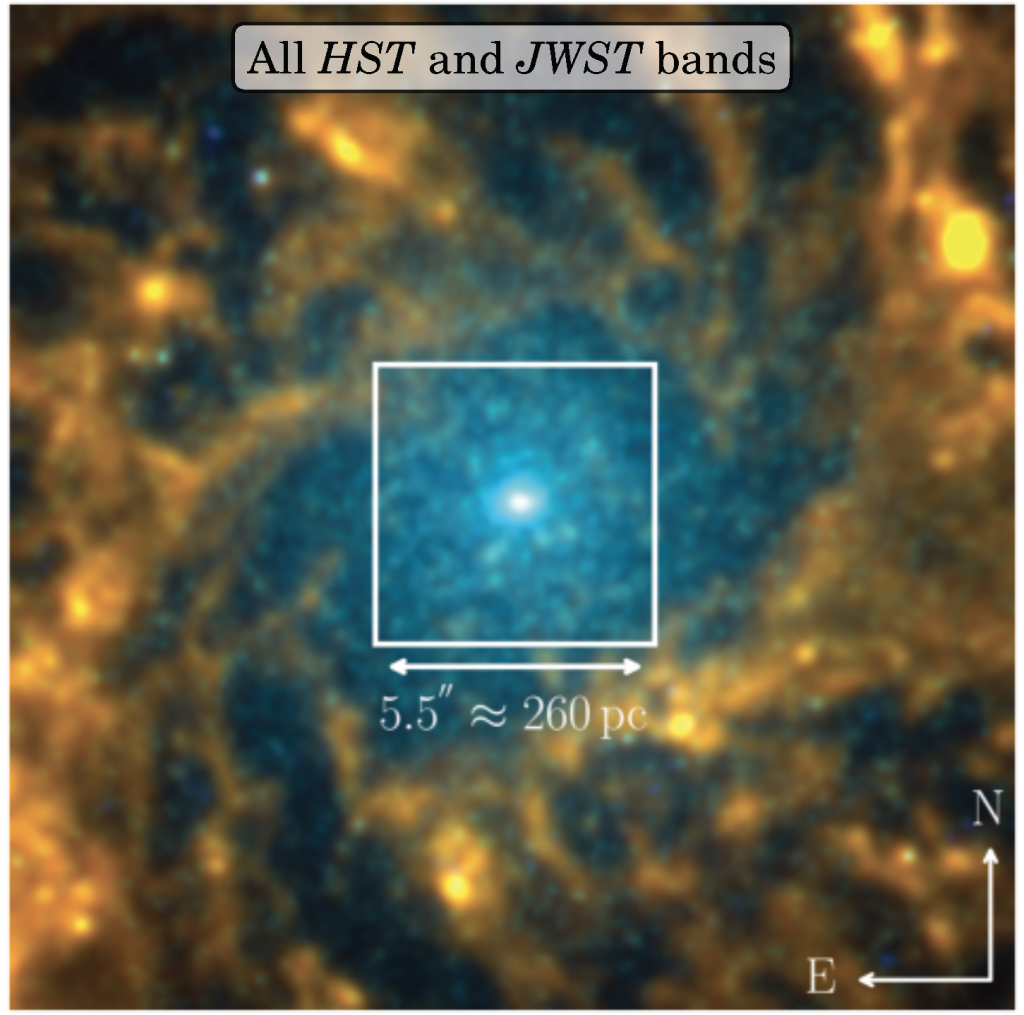
Morphological analysis and SED fitting of NSCs. I have also recently co-supervised the pioneer work “PHANGS-JWST First Results: A combined HST and JWST analysis of the nuclear star cluster in NGC 628” (Hoyer, Pinna et al., 2023). This work provided the first morphological characterization and photometric analysis of the NSC in NGC628 (M74) with JWST and at its spatial resolution. This NSC is interestingly located in a cavity with no gas or dust (see figure). While the NSC shows a roughly constant size with wavelength (about 5 pc in radius) and a roundish shape in the optical (from HST) and near-infrared ranges (from JWST), an offset, larger, and flatter structure (more than double in size) is unveiled by the mid-infrared JWST data. This structure may be mainly made up of dust due to an active galactic nucleus, previously suggested by X-ray emission. This work will be followed by the fit of JWST images of four more galaxies.
NSC stellar populations in massive spiral galaxies.
Most detailed studies of NSCs, such as the ones including their stellar-population analyses, target ETGs, and NSCs in LTGs are limited to low-mass systems (Fahrion et al. – incl. Pinna – 2022, see above). Results from Kacharov et al. (2018) suggested that NSCs in massive LTGs are more metal-poor than their ETG counterparts. However, this study included only four LTGs and massive spirals remain mostly unexplored. My research plans aim at filling this gap with different projects from IFS observations combined with simulations.
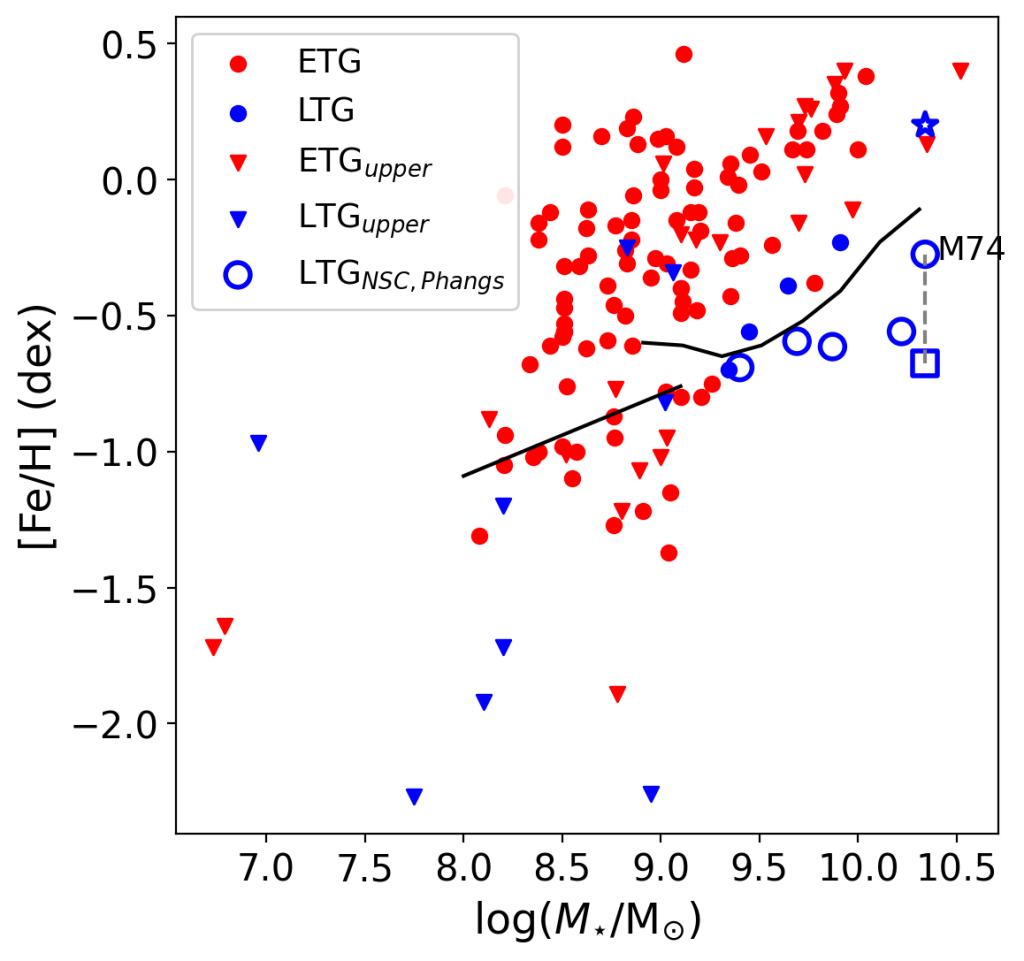
Blue open circles are from the preliminary analysis of NSCs in this work, from the integrated light in a PSF aperture. From lower to higher galaxy masses (from left to right): NGC5068, IC5332, NGC2835, NGC1385 and M74 (NGC628). The open square corresponds to the NSC in M74 after its spectrophotometric decomposition from the underlying galaxy, which is indicated with a blue star (Pinna et al. 2026).
NSCs in star-forming galaxies from PHANGS-MUSE. I am currently leading the stellar-population analysis of the NSCs in the five nucleated galaxies of the PHANGS-MUSE (Emsellem et al. 2022) sample. The PHANGS-MUSE data consist of MUSE mosaics covering the full galaxy at a large scale with a high level of detail. This allows a careful comparison of NSC properties with the host galaxy. These galaxies have stellar masses between 109 and 1010.5 solar masses, a range where NSCs in ETGs show high metallicities, higher than those of their host galaxy. In PHANGS-MUSE observations, these NSCs are not resolved, and our analysis is based on a point-spread-function (PSF) aperture. We have performed a preliminary analysis of the full sample, extracting an integrated spectrum within a PSF aperture (without «cleaning» the NSC light from the contamination of the host galaxy, see below). These results suggest that these NSCs have similar or lower metallicities than the host galaxy. Some NSCs are relatively old and this, associated with low metallicity, points to the inspiralling of one or more star clusters formed at early times, as the dominant formation scenario. Some other NSCs show ongoing star formation and very young ages, suggesting in-situ formation as dominant. In these cases, we propose recent gas accretion to explain their lower metallicity than the host galaxy. Our results are in contrast with ETG counterparts at similar stellar masses, with systematically metal-rich NSCs, more metal-rich than the host galaxy, for which in-situ formation was earlier proposed. Our analysis also shows that currently, star-forming galaxies do not necessarily form stars in their nuclei. This points to a more complex picture for massive LTGs, with no systematically preferred NSC formation channel, and reaffirms that NSCs in this type of galaxies follow their peculiar formation path, tightly linked to the evolutionary path of their host galaxy.
Detailed analysis of M74’s NSC. The preliminary analysis (above) was done by extracting spectra in a PSF aperture, including all galaxy components integrated in the line of sight. However, even within the PSF size, the NSC is contaminated by the host-galaxy light. For M74 (NGC628), I have performed a much more detailed analysis, using a two-dimensional spectro-photometric decomposition of the MUSE cube to disentangle the NSC from its host. For this purpose, I adapted the code C2D (Méndez Abreu et al., 2019), which performs morphological fits for quasi-monocromatic images corresponding to MUSE spectral pixels, to NSCs. This allows us to separate, in the MUSE data cubes, the NSCs from other galaxy components overlapped in the line of sight. C2D provides different data cubes for different components, and allowed us to analyze the NSC and the host galaxy separately, extract NSC ages and metallicities more accurately, and compare with spatially resolved properties of the surrounding galaxy.
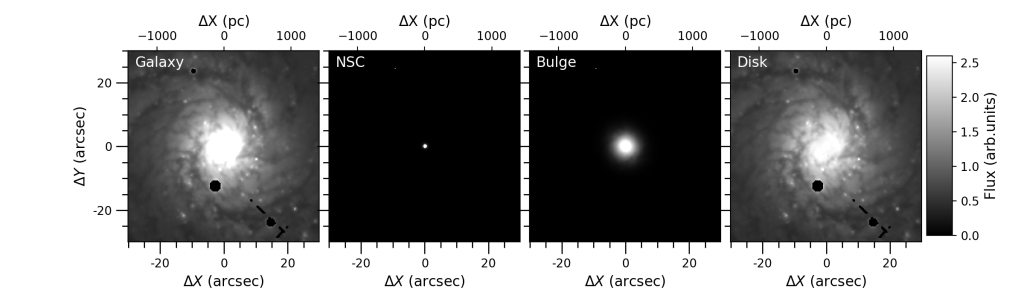
Our results show a very old and metal-poor NSC, in contrast to the surrounding regions (much older and more metal-poor NSC than from the PSF integrated spectrum, see Fig. 1 above). While similar properties were found in NSCs hosted by galaxies of different masses and/or morphological types from M 74, they are somewhat unexpected for a relatively massive star-forming spiral galaxy. The spatially resolved stellar populations of the host galaxy display much younger (light-weighted) ages and higher metallicities, especially in the central region (∼500 pc) surrounding the NSC. This suggests that this NSC formed a long time ago, and evolved passively until today, without any further growth. Our results show that the NSC was not involved in the active
recent star-formation history of its host galaxy. This is supported by the presence of the cavity shown by JWST (Hoyer, Pinna et al., 2023, see figure and text above). All this is presented in a recently accepted paper (Pinna et al. 2026). The paper shows that this method gives cleaner spectra for NSCs, disentangling them from the surrounding galaxy. This project is part of my MSCA fellowship (see below).
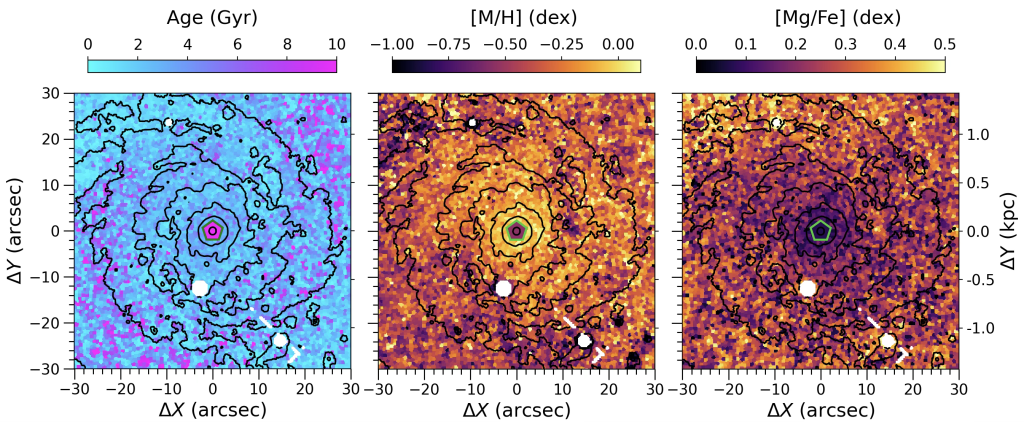
NSCs in massive spirals with MEGARA@GTC. While PHANGS-MUSE gives us a panoramic view of the galaxies hosting NSCs, we zoom right into the centers with MEGARA, a fiber integral-field spectrograph mounted at GTC in La Palma. I am leading two different projects focusing on stellar populations of NSCs in massive spirals with MEGARA, in which I apply a very similar approach as for the PHANGS-MUSE data (see above):
- NSCs in bulgeless galaxies from the BEARD survey. I am a recently appointed member of the BEARD international collaboration (June 2023, P.I.: J. Méndez Abreu), aiming at understanding the formation and evolution of bulgeless galaxies with a variety of different (photometric and spectroscopic) datasets. I am leading the science about galactic nuclei, and performing the PSF fitting, spectro-photometric decomposition and stellar-population analysis of nuclear star clusters with MEGARA data.
- “NSC formation in late-type galaxies: spatially resolving their stellar populations with MEGARA”, including three very nearby galaxies hosting NSCs, observed with the ENO-GTC program 75-GTC68/22B (P.I. García-Lorenzo B., subm. 04/04/2022). Within this project, I am supervising one BSc thesis (Laura Acosta González, ULL) and two MSc theses (Julio Bertua Marasca and Luis de la Rosa Báez, UNIR). They work on the stellar populations and kinematics of the central region of the galaxies with the integrated light, while I perform a similar detailed analysis of the decomposed NSC, as for the BEARD sample.
iFUN: Stellar populations in the center of galaxies using the new segmentation method CAPIVARA
I coordinate a new project: «Identifying different stellar structures at the centers of face-on spiral galaxies», which was selected by the iFUN team as first priority (PI: R. da Silva de Souza, University of Hertfordshire). The iFUN team has recently been created to develop novel frameworks for IFS, based on machine learning and GPU acceleration. The project that I am leading is one of the two projects that are currently carried out within iFUN, involving a subteam of about 15 people. It focuses on identifying NSCs in IFS data using the deep-learning and GPU-based segmentation code CAPIVARA. The first part of the project uses the MEGARA data from the proposal “NSC formation in late-type galaxies: spatially resolving their stellar populations with MEGARA” mentioned above. It has a related BSc thesis that I am supervising, focusing on the spectral fitting of the data cube resulting from the CAPIVARA segmentation of M51’s MEGARA data cube (Josafat González Rodríguez, ULL).
Science with a 30-40m class telescope
White paper supporting a 30-40m telescope in the Northern Hemisphere: «Why the Northern Hemisphere Needs a 30-40 m Telescope and the Science at Stake: Mapping formation pathways of nuclear star clusters across galaxies», as part of the Spanish community effort submitted to the ESO Call Expanding Horizons (Pinna et al. 2025b). This paper presented a science case focusing on the spatially resolved kinematic and stellar population internal properties of NSCs, in a large sample of over 300 galaxies within 20 Mpc in the Northern Hemisphere (most known sources are located in the North). This will be possible for the first time beyond 5 Mpc (see above, a similar study in Pinna et al. 2021, but within 5Mpc).
GALACTIC CENTERS FROM COSMOLOGICAL SIMULATIONS
Maria Skłodowska-Curie (MSCA) Fellowship: TraNSLate
I am leading the highly innovative project «TraNSLate: Tracing galaxy evolution with Nuclear Structures in Late-type galaxies«, funded with my MSCA fellowship (since Sep 2024). This project combines high-resolution cosmological simulations with state-of-the-art integral-field spectroscopy (IFS) observations to conclude on the connection between galaxy evolution and the mass assembly of central regions. The role of different large-scale processes, such as gas or star accretion, in the buildup of these regions will be quantified in 50 existing simulated galaxies from the NIHAO project (Wang et al., 2015; Buck et al., 2020). IFS observations of the central regions of a sample of spiral galaxies (see projects above) will be analyzed and interpreted with the help of results from the simulations. However, these observations have much higher resolution than current cosmological simulations. TraNSLate will also deliver one pilot simulation at much higher resolution (about a factor of 10 better than the best current NIHAO simulation, with a mass resolution of few hundreds solar masses, coupled with a softening length of tens of pc), and a detailed plan for a complete set of 20 simulations at unprecedented resolution. The pilot simulation is a less computationally expensive case to be realistically run as part of a two-year MSCA project, while the full set of 20 simulations will require a longer-term position to be entirely run (see below the future plans). We have already run the dark-matter-only simulation of the pilot galaxy, and we are currently running a full galaxy simulation at a resolution of 800 solar masses per particle. This is done within the Research Group Numerical Astrophysics: Galaxy Formation and Evolution (P.I. Claudio dalla Vecchia), in close collaboration with A. Negri (ULL/IAC), C. Brook (ULL/IAC) and A. Macciò (NYU Abu Dhabi). This new simulated galaxy will be analyzed, with a special focus on its center, and then released to the community.
Plans for the future: TraNSLateHR
After my Marie Curie fellowship, I plan to build my own team to perform, analyze and publicly release the full set of new TraNSLateHR simulations, of galaxies with different masses. The main specific objective of the project will be to finally witness the formation of observed nuclear stellar structures (e.g., clusters, disks, rings) in simulations, and quantify the relative contribution of different large-scale processes – such as gas inflow followed by in-situ star formation and stellar migration – in the buildup of these structures. In particular, we will unveil the connection between in-situ formation of nuclear structures via gas inflow to galactic disks at large scale, where most of the gas resides and where gas is accreted from outside. On the other hand, it will provide a new set of zoom-in cosmological simulations at unprecedented resolution, which will be released and used for a very large variety of science goals, such as the formation of thick and thin disks in simulations of such a high resolution. TraNSLateHR will have a huge impact not only in the field of galaxy evolution in general, but also in the theoretical community, setting a new resolution standard for cosmological simulations. These simulations will directly inform the design and scientific use of next-generation IFS instruments on 30–40 m class telescopes, enabling—for the first time—the spatially resolved study of NSC properties across large galaxy samples beyond ∼5 Mpc (white paper: Pinna et al. 2025b)